CVTC Clinical Simulation Center extends learning beyond classroom
By Alyssa Van Duyse
Chippewa Valley Technical College
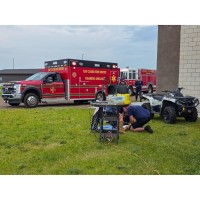
Deb Kjelstad held a toddler in her arms as the emergency sirens grew louder. An all-terrain vehicle sat idle nearby.
As the ambulance came to a stop near Kjelstad, fire medics rushed out of the vehicle to tend to the child while asking Kjelstad questions as they assessed.
Thankfully, Kjelstad, a former Chippewa Valley Technical College Radiography Program director, was just an actor in this scenario; the child was a manikin, and the event was a simulation.
Clinical simulation isn't just for students. Chippewa Valley Technical College makes it a point to train organizations to provide realistic, hands-on training that helps health care and emergency response professionals sharpen skills before they face events like these in real life.
One longstanding partnership is between CVTC and the Eau Claire Fire Department. Every summer, firefighters and paramedics work alongside CVTC's Clinical Simulation Center team in training scenarios designed to replicate emergencies that don't happen often.
During this year's training at the Eau Claire Event District, crews prepared for the busy summer festival season by responding to a simulated medical emergency in an environment like one they may encounter during any large public event.
"These are high-acuity, high-stress situations that fortunately don't happen very often," said Natasha Myre, deputy chief of operations/EMS for the Eau Claire Fire Department. "Simulation allows us to practice those skills in a realistic setting so we're better prepared if they ever do happen."
Unlike traditional skills practiced on a manikin in a classroom, CVTC's simulations recreate emergencies responders may face in the field. Scenarios can include bystanders, family members, difficult access to patients, environmental distractions and other real-world challenges that require crews to think critically while delivering care.
Planning for the training begins six to eight months in advance. CVTC simulation staff, the fire department and the department's medical director collaborate to develop scenarios that reinforce current protocols while introducing new challenges and opportunities for learning.
For Theresa Meinen, CVTC's simulation education manager, realism is what transforms training into lasting learning.
"We think about every detail," Meinen said. "We use high-fidelity simulators that can breathe, bleed, have pulses and respond to medications, but we also add bystanders, vehicles, sounds and realistic locations. All of those pieces help participants feel like they're responding to an actual emergency."
The Event District itself added another valuable layer to the exercise. As one of the fire department's response areas during major community events, the training gave crews an opportunity to become more familiar with building layouts, access to the location and the unique challenges of responding to emergencies on the grounds.
Every scenario concludes with a structured debrief, allowing participants to reflect on what went well, identify opportunities for improvement and reinforce what was learned before returning to service.
While CVTC's Clinical Simulation Center is best known for preparing future health care professionals, community partnerships like this are a core part of CVTC’s mission.
"Our mission isn't only to educate our students," Meinen said. "It's also to provide education for the community. Whether someone graduated from CVTC or another institution, we want health care and emergency professionals to know they can come back to us throughout their careers to continue learning and improving their skills."
By opening its nationally accredited simulation resources to organizations throughout the region, CVTC helps ensure first responders and health care professionals are ready for all scenarios, which ultimately strengthens the health and safety of communities throughout the Chippewa Valley.
Chippewa Valley Technical College
-
ALYSSA VAN DUYSE Content Strategist/Writer/Media Relations
- July 29, 2026
- Send Email
